Das Projekt ist bereits abgeschlossen
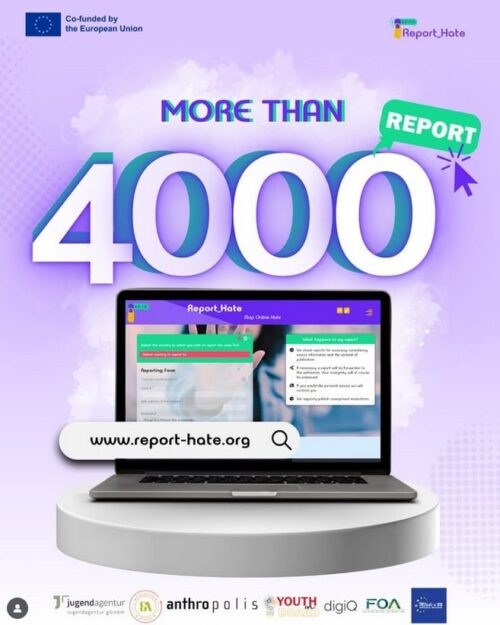
Das ERASMUS+-Projekt „Report Hate“ mit Partnerorganisationen aus Israel, Nordmazedonien, Spanien, Ungarn, Kroatien und der Slowakei hat zum Ziel, jungen Menschen die Möglichkeit zu geben, aktiv gegen Hate Speech zu werden. Dafür wird das erste länderübergreifende Hate-Speech-Meldeportal speziell für junge Menschen entwickelt und mit einer breit angelegten Social-Media-Kampagne bekannt gemacht.
November 2023 bis Oktober 2025
The ERASMUS+ project “Report Hate,” with partner organizations from Israel, North Macedonia, Spain, Ungarn, Croatia, and Slovakia, aims to give young people the opportunity to take active measures against hate speech. We develope the first transnational hate speech reporting portal specifically for young people and promote it with a broad-based social media campaign.
November 2023 until October 2025
Transnational Hate Speech Reporting Portal (Due to high costs, the portal is only able to remain online until March 2026 – the URL afterwards redirects to the reporting feature of the German partner “REspect! im Netz”)
Project channel on Instagram
Hate Speech Categorisation Handbook: The handbook is intended to enable employees of all participating organizations to recognize hate speech and assign it to its various forms. It lists 10 categories of hate speech with subcategories and detailed examples. It also explains what hate speech actually is and how hate speech can be distinguished from legitimate content. These are each explained in the text and with examples.
Comparative country analysis of reports submitted during the project period: The comparative country analysis shows which forms of hate speech were most frequently reported in each country, what patterns and differences emerged, and which political contexts shaped the reports. It examines concrete examples of the types of hate speech most commonly reported in each country and places them in context. This provides a detailed picture of how hate speech manifested in different social and political environments, and how similar or different responses and dynamics were across the participating countries.
Handout on working with DSCs: The handout provides practical guidelines for youth organisations on how to cooperate with Digital Services Coordinators under the EU Digital Services Act, including reporting procedures, crisis response, and contributions to platform accountability and young people’s online safety.
Handout on obtaining Trusted Flagger status: The handout explains how youth organisations can obtain “Trusted Flagger” status under the Digital Services Act. It describes eligibility criteria, preparation steps, the application process, and the key responsibilities required for effective reporting of hate speech.
Handout on building networks against hate speech: The handout offers practical guidance on building networks to combat hate speech, with a focus on roundtables, workshops, facilitation methods, communication strategies, and joint problem-solving in multi-stakeholder settings.

| Cookie | Dauer | Beschreibung |
|---|---|---|
| cookielawinfo-checkbox-analytics | 11 months | This cookie is set by GDPR Cookie Consent plugin. The cookie is used to store the user consent for the cookies in the category "Analytics". |
| cookielawinfo-checkbox-functional | 11 months | The cookie is set by GDPR cookie consent to record the user consent for the cookies in the category "Functional". |
| cookielawinfo-checkbox-necessary | 11 months | This cookie is set by GDPR Cookie Consent plugin. The cookies is used to store the user consent for the cookies in the category "Necessary". |
| cookielawinfo-checkbox-others | 11 months | This cookie is set by GDPR Cookie Consent plugin. The cookie is used to store the user consent for the cookies in the category "Other. |
| cookielawinfo-checkbox-performance | 11 months | This cookie is set by GDPR Cookie Consent plugin. The cookie is used to store the user consent for the cookies in the category "Performance". |
| viewed_cookie_policy | 11 months | The cookie is set by the GDPR Cookie Consent plugin and is used to store whether or not user has consented to the use of cookies. It does not store any personal data. |